





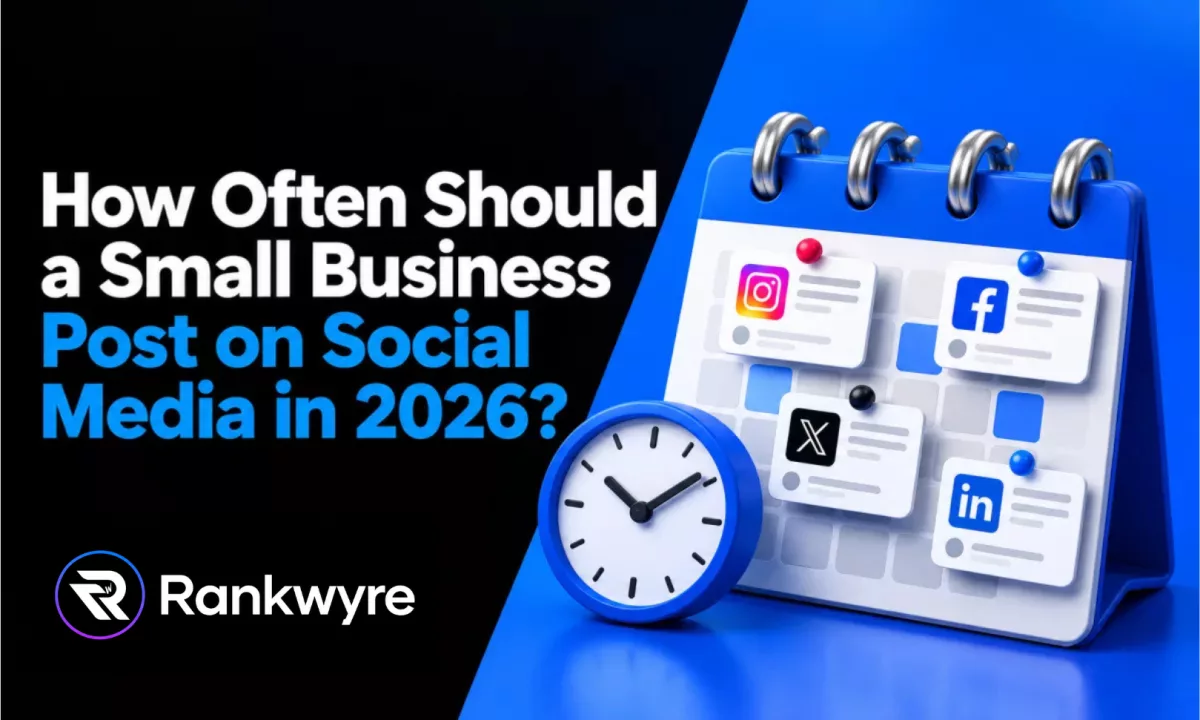
How Often Should a Small Business Post on Social Media in 2026?

Summarize this article with AI
Most posting guides are written for a social media manager with a team, a content calendar, and a budget for video. If you are a small business owner doing this yourself, that advice does not fit. You do not have two hours a day. You have maybe two hours a week, and a phone.
The honest answer to "how often should I post" is a range, not a single number, because it depends on the platform and on what you can sustain without burning out in six weeks. This guide gives a recommended minimum for each platform a local or service business actually uses, a sample week built around one job, one customer, and one tip, and the two things that matter more than raw frequency: showing up consistently and replying to the people who already found you.
We also cover what to track so you know if any of this is working, and the tools that make two hours a week enough.
Key Takeaways
- There is no official minimum. Instagram's own ranking explanation does not name a required posting frequency, and Google's own Business Profile posts help page does not either.
- Buffer's 2026 posting frequency guide found accounts posting 3 to 5 times a week on Instagram get about 12 percent more reach per post than accounts posting once or twice a week.
- On LinkedIn, Buffer's analysis of more than 2 million posts found 2 to 5 posts a week adds about 1,182 more impressions per post than posting less.
- On TikTok, Buffer's analysis of 11.4 million posts found 2 to 5 posts a week adds up to 17 percent more views per post than posting once weekly.
- Google Business Profile posts are archived after 6 months if you do not set a date range, so a profile with no recent posts is showing visitors old information.
- A realistic weekly plan for two hours takes one finished job, one customer story, and one quick tip, and turns each into a post for every platform you run.
- Consistency beats frequency. Buffer's 2026 state of social media engagement study found what it calls a "no-post penalty": accounts that skip a week of posting underperform their own baseline growth rate, even in the weeks they do post.
- Track profile visits, calls, direction requests, and DMs, not likes. Likes do not book jobs.
The Short Answer
Post often enough that a visitor who checks your profile sees something from the last week or two, and reply to every comment, review, and DM the same day. That is the real bar. Everything below is how to hit it in two hours a week without it becoming a second job.
Nobody, not Instagram, not Google, not TikTok, publishes a rule that says "post X times or you get punished." What the platforms' own guidance says instead is that recent activity and how people react to it are what carries weight. Instagram's own explanation of its ranking system lists "when a post was shared" and how people respond to it among the signals it weighs, alongside thousands of others, but never states a frequency requirement. Google's Business Profile help page does not tell you how often to post either. It does say something more useful: posts older than 6 months get archived unless you set a date range, so a profile that has not posted in months is quietly going stale on the map result people are looking at right now.
Our Recommended Minimum Cadence, by Platform
The numbers below are Rankwyre's own recommendation for a small business with limited time, built from what the research below shows and scaled down to what one person can actually keep up. They are a floor, not a target to chase past.
| Platform | Rankwyre's recommended minimum | Why |
|---|---|---|
| Google Business Profile | 1 post a week | Posts fall out of view after 6 months without a set date range, and a Google Business Profile is often the first thing a local searcher sees before your website. |
| 2 to 3 feed posts a week | Buffer's data shows the reach gain from 3 to 5 posts a week over 1 to 2, so 2 to 3 gets most of that lift without daily production. | |
| 2 to 3 posts a week | If your customers use Facebook for hours, reviews, and community posts, keep it active there too, even if they also follow you on Instagram. | |
| TikTok | 1 to 2 posts a week, only if you can make them | Buffer's study found the biggest efficiency jump is from 1 post a week to 2 to 5, so start there instead of aiming for daily. |
| LinkedIn (B2B) | 2 to 3 posts a week | Buffer's analysis found the impression lift starts at 2 to 5 posts a week compared with once a week, so the floor here is 2, not 1. |
If you run all five, that is roughly 7 to 11 posts a week. Most small businesses do not need all five. Pick the one or two platforms your actual customers use and do those well before adding a third.
A Realistic Weekly Plan: One Job, One Customer, One Tip
You do not need seven different ideas a week. You need three, reused across platforms. Most weeks give you at least one finished job, one happy customer, and one thing you know that your customers do not.
- One job. A before-and-after photo or a 15-second clip of the work, with the town or neighborhood named. This is your Google Business Profile post and your Instagram or Facebook post for the week.
- One customer. A short quote or a screenshot of a review, with a thank-you caption. This does double duty: it is proof for new visitors and it is the reply you owe the customer who left it.
- One tip. Something you would tell a customer for free on a call anyway ("check this before you call anyone about a leak," "here's how to tell if your quote is missing something"). This is the post most likely to get saved or shared, and the one worth trying on TikTok or Reels if you run video at all.

Here is how that fills a two-hour week:
- Monday, 20 minutes: Post last week's finished job to Google Business Profile and Facebook. Reply to any weekend reviews and comments first.
- Wednesday, 30 minutes: Post the customer story to Instagram and Facebook. Reply to comments and DMs from Monday's post.
- Friday, 40 minutes: Film or write the tip. Post it everywhere you run, including LinkedIn if you sell to other businesses. Reply to everything from earlier in the week.
- Remaining time: Reply to anything new, and take one photo or 10 second clip on your next job site for next week's post so you are not starting from zero.
That is three original posts, reused across three to four platforms, plus daily replies, in under two hours. It is a floor, not a ceiling. If you have more time or a team member who enjoys this, add a second job post or a Stories habit on Instagram.
What Matters More Than Frequency
Frequency is the easiest thing to measure and the least important thing to get right. Three things matter more.
Consistency. Buffer's 2026 state of social media engagement study, based on 4.8 million channel-weeks across roughly 161,000 profiles, found that accounts that skip a week of posting underperform their own baseline growth rate, even in the weeks they do post. Posting twice a week every week beats posting five times one week and then going dark for a month. Instagram's own ranking explanation backs this up indirectly: recency is one of the signals it weighs, so a profile with nothing recent has less to rank in the first place.
Local proof. A generic stock photo with generic advice looks like every other business posting that week. A photo from a real job in a real neighborhood, a real customer's words, or a real answer to a question your customers actually ask does not. If your photos are the weak link, that is a smaller fix than most owners think; see our brand photography service if you would rather have a set of real, usable shots ready to go than rely on phone photos from the job site.
Replying to comments and reviews. A post nobody responds to is a post that did nothing. When someone comments, asks a question, or leaves a review, answering the same day tells the next visitor that a real person is behind this business, and it is often the difference between a comment and a booked job. This is also free: it costs time, not a production budget.
How to Measure Whether It Is Working
Likes and follower counts feel good and mean almost nothing for a local business. Track the numbers that connect to actual customers instead.
- Profile visits. How many people tapped through to your Google Business Profile or Instagram profile after seeing a post. Available in each platform's own insights.
- Calls. Google Business Profile shows call clicks straight from your listing. If posting more does not move this number over a month or two, the posts are not reaching the right people.
- Direction requests. Also in Google Business Profile insights. This is someone who decided to physically show up, which is as close to a booked job as a metric gets for a storefront.
- DMs and comments. A message asking "do you serve my area" or "how much for X" is a warmer lead than a like will ever be. Count these by hand each week if your volume is low; it takes two minutes.
Check these monthly, not daily. A single slow week does not mean the plan is broken, and a single good week does not mean you found a formula to repeat forever.
Common Mistakes
- Posting in bursts, then going quiet for a month. This is worse than a lower, steady frequency, because Buffer's 2026 engagement study found accounts lose their baseline growth rate in the weeks they skip. The fix: pick the lowest number you can actually sustain every single week, and only raise it once that habit sticks.
- Posting and never replying. A comment or DM that sits unanswered for days reads as "nobody is actually running this account." The fix: check comments and messages daily, even on days you do not post, and answer the same day.
- Treating every platform the same. A dense paragraph that works on LinkedIn falls flat on Instagram, and a Reel format does not translate to a Google Business Profile post. The fix: reuse the same idea (the job, the customer, the tip) but write and shoot it differently for each platform instead of copy-pasting one post everywhere.
- Letting the Google Business Profile go stale. It is easy to post to Instagram regularly and forget the listing that shows up first in local search. The fix: since posts archive after 6 months without a set date range, put a Google Business Profile post in the same weekly routine as everything else, not as an afterthought. See our Google Maps and local SEO service if your profile needs a full setup, not just posts.
- Chasing a frequency number instead of a customer. Hitting "5 posts a week" with weak content does not out-rank one strong post a real customer stopped to read. The fix: if you are choosing between posting more and posting better this week, post better.
Tools
| Tool | Primary use |
|---|---|
| Google Business Profile app | Post updates, offers, and events, and see calls, direction requests, and profile visits |
| Buffer or Later | Schedule a week of posts in one sitting instead of remembering to post daily |
| Instagram and TikTok native camera | Short job-site clips shot on the spot beat staged content for this use case |
| Canva | Turn one photo into a captioned graphic for Facebook, Instagram, and Google Business Profile in a few minutes |
| Your phone's Notes app | Keep a running list of customer quotes and quick tips so Friday's post is never a blank page |
FAQs
For most platforms, 2 to 3 posts a week is a workable minimum, based on Buffer's research showing the biggest reach and engagement gains happen between posting once a week and posting 3 to 5 times, with smaller gains after that. Pick a number you can sustain every week rather than the highest number you can hit once.
If you are only running one platform, put the time you would have split elsewhere into that one, aiming for the higher end of the range in the cadence table above, plus daily replies to comments and messages. One platform done consistently beats three platforms posted to occasionally.
Most small businesses do not need to post daily on any single platform. Instagram Stories are the exception, since they disappear after 24 hours, so posting one daily costs little and keeps your profile looking active. Feed posts, Google Business Profile posts, and LinkedIn posts work fine at 1 to 5 times a week based on the research above.
Not directly. Instagram's own explanation of how ranking works lists recency and engagement among the signals it considers, but does not state a posting frequency requirement. Posting more gives you more chances to earn engagement, which is what the platforms say they weigh, but a single strong post plus fast replies can outperform several weak ones.
A photo with a short caption still works on Google Business Profile, Facebook, and Instagram. Save video for the platforms that need it, like TikTok and Reels, and only add those once your photo-and-caption routine is steady.
Reuse the idea, not the exact post. The same job, customer story, or tip can become a Google Business Profile update, a Facebook post, and an Instagram caption, but each should be written and formatted for how people actually use that platform.
Conclusion
Skip the debate over the perfect number. Pick a minimum from the table above that fits your real two hours a week, build it around one job, one customer, and one tip, and reply to everyone who responds. That combination beats a higher posting count with no replies and long gaps between bursts.
If keeping this up every week is the part that keeps slipping, Rankwyre's social media service can take the posting and replying off your plate while you run the business. Get started with Rankwyre and we will scope a plan around the platforms your customers actually use.
About the author:
Rankwyre Team
Digital technology company, Miami, Florida
Rankwyre is a digital technology company based in Miami, Florida. It builds custom websites, ecommerce stores, web apps, CRM systems, and dashboards, then runs the SEO and ads that bring in customers.